Why Cardiac Remote Monitoring Struggles Without Better Data Infrastructure

Connectivity is only the beginning.
By Robert Kelly, Founder and CEO, Heart Rhythm International.
A patient presents to an emergency department, not their usual hospital. They have an implanted cardiac device. The clinical team needs to understand their device history, recent transmissions, and any flagged alerts.
None of that information is accessible.
In some cases, the receiving hospital is a smaller general or primary care facility with no capability to perform a device interrogation directly. The team is entirely dependent on remote monitoring transmissions being relayed from the patient’s usual tertiary centre. Without that connection, the only alternative may be transfer to a centre that can interrogate the device. Neither option is straightforward. Both introduce delay.
The remote monitoring data exists, but it lives in a platform tied to another institution. The transmission record may be there. The alerts may have been reviewed. But none of it is visible to the team now responsible for that patient’s care.
A cardiac device transmission is not a clinical workflow. It is a piece of information that still needs context, interpretation, and a decision behind it.
That is the gap at the centre of many cardiac remote monitoring programmes today. The technology can transmit data, but the data often arrives without enough clinical context to make it truly useful at scale.
Remote monitoring is rightly seen as one of the most promising models in modern cardiac care. It can reduce unnecessary hospital visits, support earlier intervention, and help clinical teams focus attention where it is most needed. But the full value of remote monitoring will not be delivered through connectivity alone. It depends on the data infrastructure underneath it.
A transmission only becomes meaningful when it can be understood alongside the implant history, the device type, previous interventions, known arrhythmias, medication changes, symptoms, and recent clinical events. Without that context, even high-quality device data has limits.
This is where many remote monitoring environments begin to struggle. The transmission sits in one place, the implant record in another, the symptoms somewhere else, and key clinical events in a separate system again. Clinicians are left to assemble the real picture themselves.
That matters because more data does not automatically mean better care.
Cardiac teams are already under significant pressure. Physiologists, nurses, and consultants do not need more disconnected portals, more fragmented reports, or more technical alerts without context. They need systems that help them see what matters quickly, clearly, and safely.
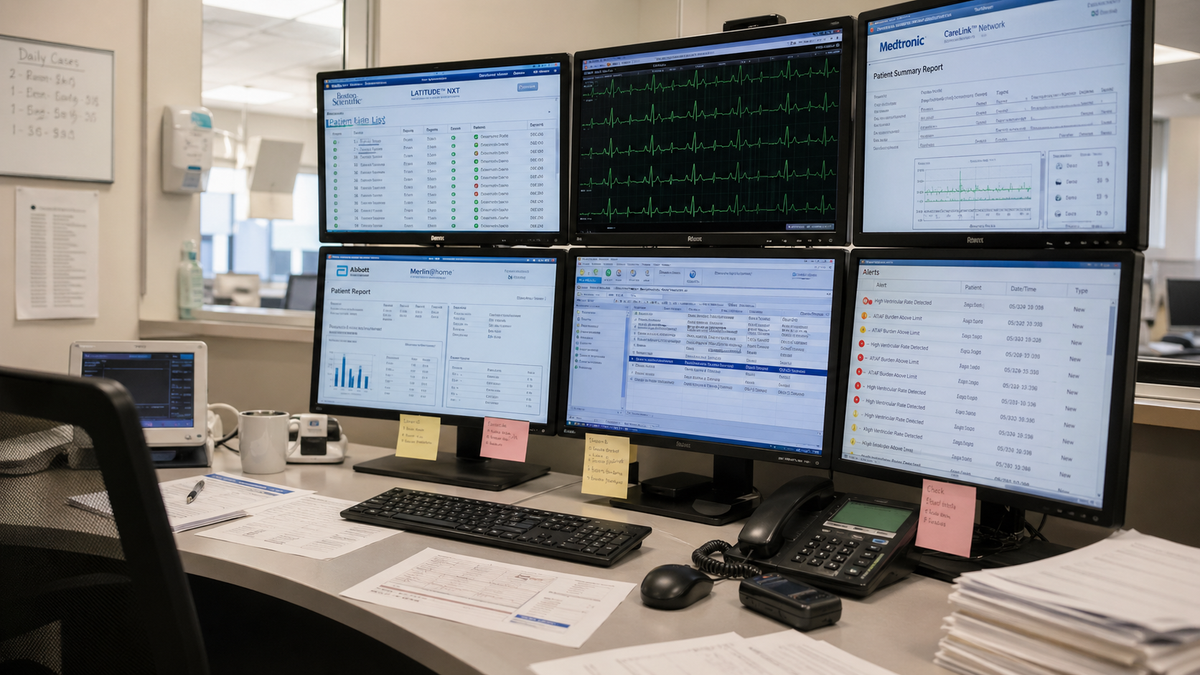
If the underlying data is fragmented, remote monitoring can easily add complexity rather than reduce it. Teams end up reviewing information across multiple systems and relying on manual interpretation to connect the dots. The service may still function, but it depends too heavily on effort, memory, and local workarounds. That is difficult to scale and even harder to optimise.
This pressure has intensified since the Covid pandemic. The push to connect more cardiac devices to remote monitoring services and reduce in-person hospital visits accelerated rapidly. That shift brought real benefits, but the infrastructure required to manage the resulting increase in transmission volumes has not kept pace. Services that were already stretched are now managing a substantially higher workload with systems that were not designed for it.
The real distinction is not simply whether data is available. It is whether the data is structured and connected.
Structured data can be searched, trended, prioritised, and analysed. It supports better workflows and makes it easier to identify clinically important changes over time. It also creates the foundation for more advanced capabilities, including predictive analytics and earlier identification of deterioration.
By contrast, when too much of the workflow depends on PDFs, scanned reports, free text, or disconnected manufacturer portals, the value of remote monitoring is reduced. Useful information may still be there, but extracting it consistently becomes slower, harder, and more resource-intensive.
This is why the data layer matters so much. If remote monitoring data sits outside the wider clinical record, the service will always have limits. Clinicians may still be able to deliver good care, but the process becomes more manual and less resilient as volumes grow.
This is also why the current excitement around AI needs to be grounded in reality.
AI has real potential in cardiac remote monitoring. It could help teams detect patterns earlier, prioritise patients more effectively, and identify signs of deterioration before they become urgent. But AI will not compensate for weak foundations. If the underlying data is incomplete, inconsistent, or disconnected from the clinical workflow, then any intelligence layer built on top of it will have limited impact.
Before asking what AI can do for remote monitoring, health systems need to ask whether their data environment is capable of supporting it.
The direction of travel is clear. Remote monitoring will continue to expand, and alert-based models of follow-up will become more common. That represents a meaningful step forward in how cardiac care is delivered. But it cannot succeed without the systems and infrastructure required to make transmission analysis and patient management more efficient. The clinical ambition is right. The infrastructure needs to catch up.
What better infrastructure looks like is not complicated in principle, even if it takes time to build. It means capturing data in structured form wherever possible. It means connecting device transmissions to the broader patient record. It means giving clinical teams visibility of the patient journey over time, not just a series of isolated technical reports. And it means designing workflows around clinical usefulness, rather than around the limitations of disconnected systems.
Cardiac remote monitoring has enormous potential. It can improve patient care, support earlier intervention, and make better use of scarce clinical capacity. But it will not succeed on transmission alone.
It will succeed when the data beneath it is structured, integrated, and clinically meaningful.
Without that, remote monitoring risks becoming another source of complexity in an already stretched system.