Ireland joins the European story on dual-chamber leadless pacing
Ireland's first dual-chamber leadless pacemaker system was completed at the Mater Misericordiae University Hospital and captured on HRI's national cardiac device registry in real time. Here is why that matters for the future of cardiac device evidence.

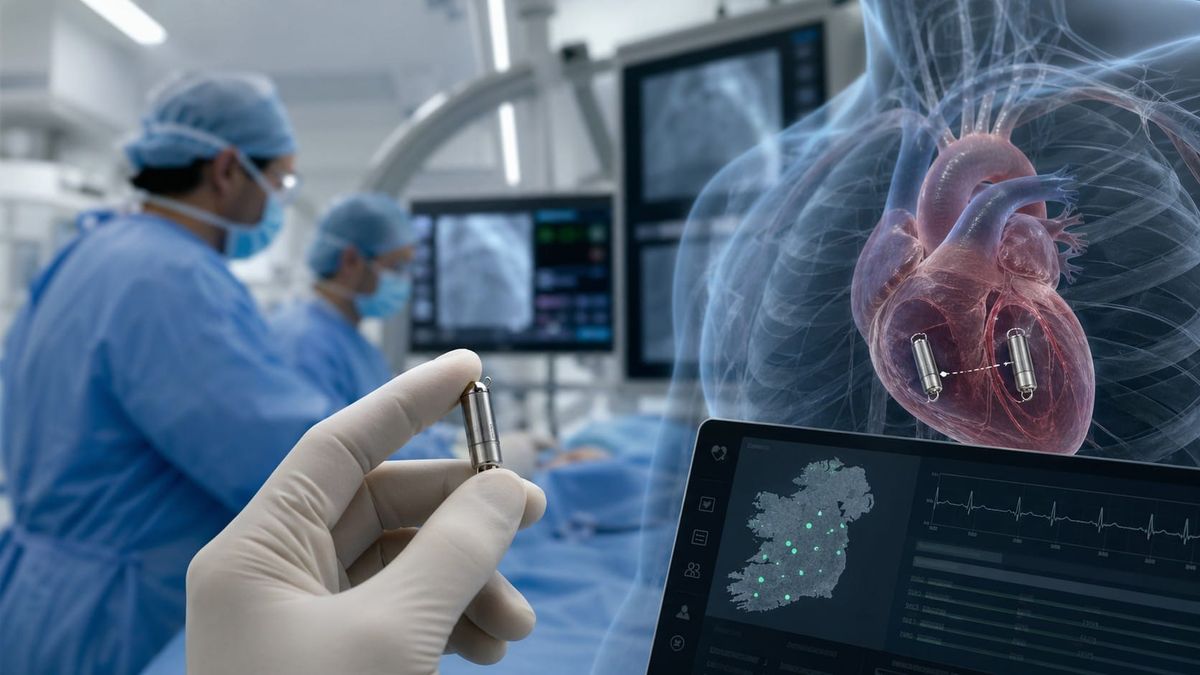
Today, the Mater Misericordiae University Hospital in Dublin completed Ireland's first dual-chamber leadless pacemaker system.
During the procedure, the case was captured on Heart Rhythm International's national cardiac device registry.
That detail matters.
This was not retrospective data entry after the event. It was national registry infrastructure working in real time as a new category of cardiac device entered clinical practice in Ireland.
Leadless pacing has been one of the most important advances in cardiac rhythm management over the past decade. Until recently, however, its role was largely limited by the absence of true dual-chamber functionality. That is now changing. Dual-chamber leadless systems, where two separate intracardiac devices communicate wirelessly and function together as one therapeutic unit, represent a major step forward in device therapy.
Recent European data, including work published in the Polish Heart Journal by the Tajstra group at the Silesian Centre for Heart Diseases in Zabrze, points to the clinical feasibility of this new class of pacing technology. Their work adds to the growing evidence base around short-term safety, procedural success and electrical performance in carefully selected patients, compared with traditional transvenous systems.
But early feasibility is only the beginning.
The questions that matter most to clinicians, patients, payers and manufacturers are longitudinal.
How does battery longevity behave over years of varied pacing burden? How do thresholds drift in real-world programming? What does replacement or retrieval look like at scale? How do outcomes compare across patient groups, across centres and across device generations?
Battery longevity is already emerging as a central question for this device class. The continuous wireless communication between atrial and ventricular devices that makes dual-chamber leadless pacing possible comes at an energy cost. Early indications suggest that dual-chamber battery life will be significantly shorter than the estimates for single-chamber leadless systems, making device retrieval and replacement not just theoretical considerations but near-certain clinical realities for many patients. That changes the evidence requirements fundamentally. A device that will need to be replaced within a patient's lifetime demands longitudinal data on retrieval outcomes, replacement procedures, and cumulative complication rates across the full device lifecycle.
These are not questions any single hospital can answer in isolation.
They are the questions national longitudinal registries were built to answer.
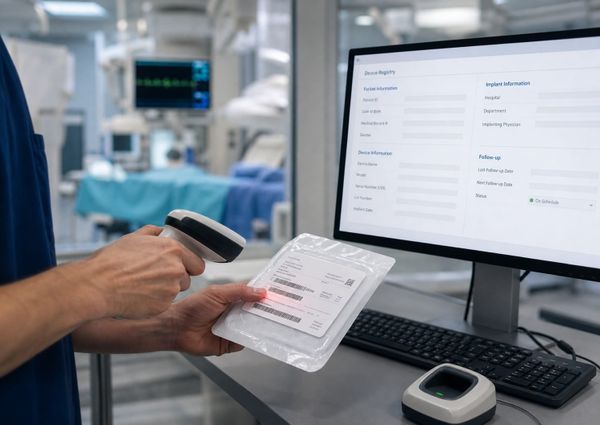
This is the work HRI has been doing since 2008. Heart Rhythm International operates Ireland's national cardiac device registry, capturing implant procedures, device details, lead details and follow-up data across public and private cardiac services. Over that period, more than 100,000 cardiac device implant procedures and approximately one million follow-ups have been recorded on the HRI platform.
The infrastructure is already in place. The data model is mature. The clinical relationships are established. Most importantly, the habit of recording device data as part of clinical workflow already exists.
That principle was tested in real time today.
The case at the Mater involved a new category of device interaction: physically separate leadless devices functioning together as one communicating dual-chamber system. Our technical team worked with the implanting centre during the procedure to ensure the registry architecture could properly represent this configuration.
The atrial leadless component had been implanted at the same hospital in an earlier procedure, also captured on HRI. Today's procedure added the ventricular component and enabled wireless communication between the two devices, completing Ireland's first dual-chamber leadless pacing system. The full patient pathway, from the initial atrial implant to today's completion, is now recorded longitudinally on the registry.
That matters, because the data model decisions made at the beginning of clinical adoption shape how every future case is recorded, followed and analysed.
A new device class needs more than successful first cases. It needs structured longitudinal evidence from the moment it enters real-world practice. Every field captured correctly today becomes part of the evidence base clinicians will rely on tomorrow.
This is what real-world evidence infrastructure looks like in practice.
Not retrospective audits. Not isolated spreadsheets. Not fragmented post-market datasets. Population-level, longitudinal capture beginning at the moment a new device enters clinical use, following both the device and the patient across the full lifecycle of care.
Countries with mature cardiac device registries have shown the value of this approach for decades. Sweden's national ICD and Pacemaker Registry, established in 1989, remains one of the important historical reference points for structured, long-term device follow-up. Ireland now has its own mature national infrastructure in HRI, capturing cardiac device data across public and private care settings and supporting the next generation of evidence-led device adoption.
The Irish data is now part of the European story on dual-chamber leadless pacing.
Each implant captured properly today becomes a data point that strengthens the evidence base behind every clinical decision tomorrow. That is how new technologies move from promising innovation to confident mainstream practice.
The technology is ready.
The infrastructure is ready.
The evidence base for the next generation of cardiac devices is now being built one implantation at a time.
Sincere thanks to Professor Kevin Walsh, Chief I Cardiac Physiologist Ray Conboy, Clinical Specialist Cardiac Physiologist Emmet O'Connor and the electrophysiology team at the Mater Misericordiae University Hospital for a successful procedure and for engaging with HRI to ensure the registry architecture was adapted to allow this new category of procedure to be properly recorded. National registries only work when implanting centres treat data capture as part of the procedure, not as an afterthought.
The Mater team set the standard today.