When a device needs to be found
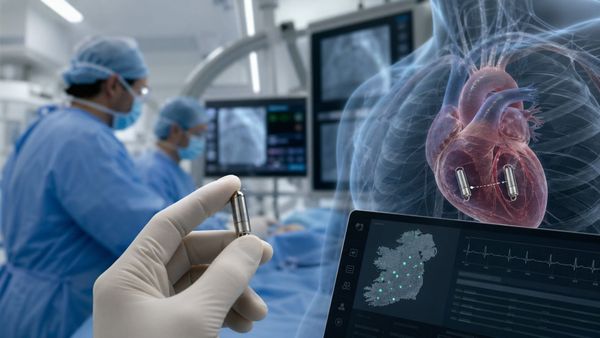
When a manufacturer issues a Field Safety Notice, the question is simple: which patients have this device? Patient safety depends on infrastructure, not just intention.

Patient safety in cardiac device care depends on infrastructure, not just intention
Every cardiac implantable device carries a serial number. Every manufacturer maintains records of where their devices were shipped. Every hospital keeps records of which patients received which devices. On paper, the system works. In practice, it has gaps that only become visible when something goes wrong.
When a manufacturer identifies a potential safety issue with a cardiac device, they issue a Field Safety Notice. The notice reaches hospitals. The hospitals then need to identify every patient who has that specific device, confirm whether they are affected, and take whatever clinical action is required. The question is simple: which patients have this device? The answer should be simple too. It rarely is.
In a health system where device records sit inside individual hospital systems, the response to a Field Safety Notice depends on the quality of local record-keeping, the availability of staff to search those records, and the speed at which each hospital can cross-reference a serial number with a patient. Most hospitals manage this carefully, but the process still depends on local systems, local capacity, and local data quality. The result is variation. Variation in response times, variation in completeness, and variation in whether every affected patient is actually identified and contacted.
This is not a criticism of hospitals. It is a description of what happens when a national safety function depends on fragmented local infrastructure. The intention is always there. The architecture to deliver on that intention consistently, across every hospital, for every device, is not.
Where traceability begins
The foundation of every patient safety function in cardiac device care is the accuracy of the data captured at the moment of implantation. If the device serial number is wrong, the Field Safety Notice response fails. If the lead details are incomplete, the follow-up record is unreliable. If the expiry date is missing, a basic quality check has been skipped. Everything downstream depends on what happens in the first few minutes after a device is implanted.
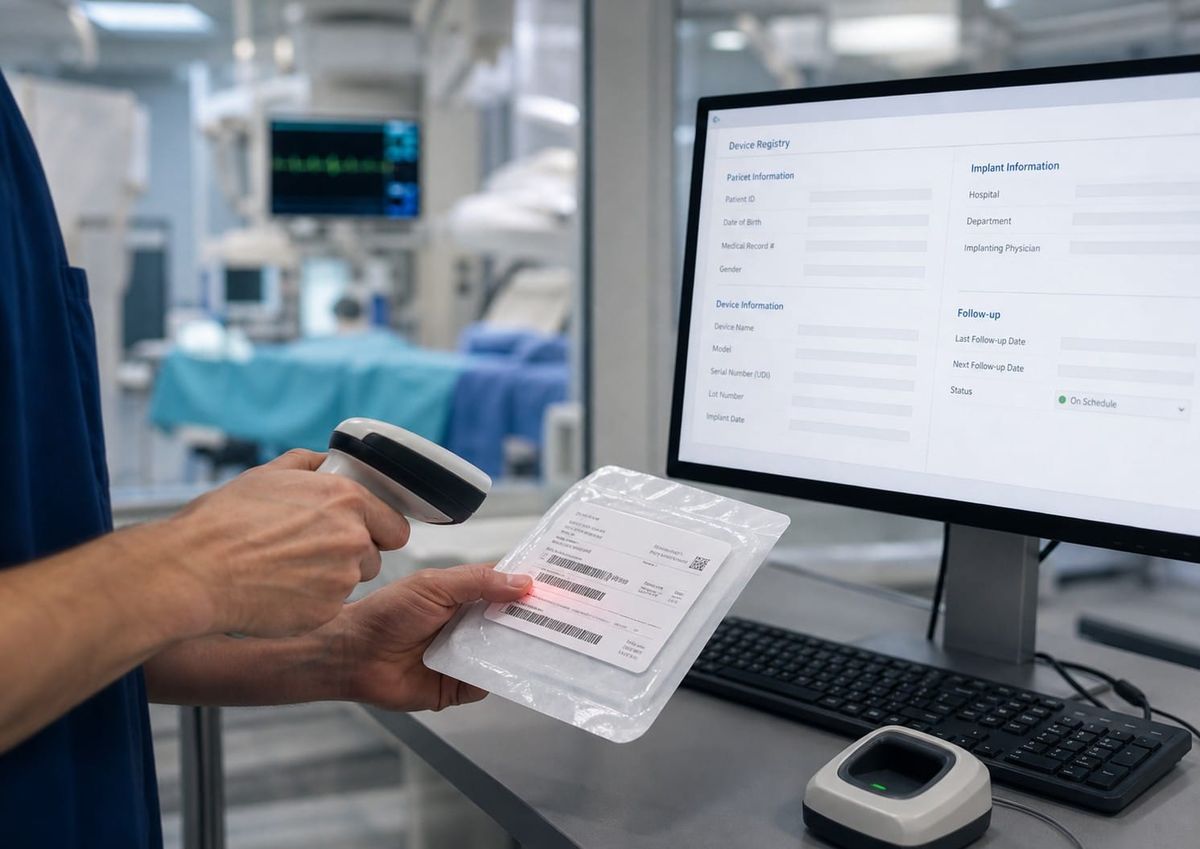
This is why data quality at the point of implant matters. When a device or lead is scanned rather than manually transcribed, the Unique Device Identifier, the serial number, the expiry date, and the full device and lead specifications are captured exactly as the manufacturer encoded them. No transcription errors. No misread serial numbers. No missing fields. The data enters the registry clean, and it stays clean through every subsequent follow-up, every cross-hospital transition, and every Field Safety Notice query for the lifetime of that device. Where manual entry has historically introduced errors, verification at follow-up can detect discrepancies between the serial number in the registry and the serial number read directly from the device, allowing corrections that would otherwise persist in the traceability chain indefinitely.
This is not just a matter of good practice. Under the EU Medical Device Regulation, health institutions are required to store and keep, preferably by electronic means, the UDI of Class III implantable devices. Active implantable devices and their accessories are classified as Class III under MDR classification rules. Cardiac pacemakers, ICDs, and CRT devices therefore fall within the category of high-risk implantable devices where electronic traceability matters. The regulation recognises what the clinical community has long understood: that electronic recording and traceability of high-risk implantable devices is a patient safety requirement, not an administrative preference. The question for any health system is not whether to comply, but how. The answer is infrastructure that captures UDI data accurately at the point of origin, maintains it through the full device lifecycle, and makes it queryable when a safety event occurs.
What national infrastructure changes
A national cardiac device registry that captures implants across the hospital network, with the serial number of each device and the identity of each patient, transforms Field Safety Notice response from a hospital-by-hospital search into a single query. Which patients in the country have this device? Affected patients can be identified far more quickly and consistently. The gaps that exist in fragmented systems are significantly reduced.
This is what Heart Rhythm International has been doing in Ireland for 18 years. When a manufacturer issues a Field Safety Notice, HRI can identify affected patients across the national hospital network, public and private, and provide that information to the relevant clinical teams immediately. The serial number is in the registry. The patient is in the registry. The implanting hospital is in the registry. The current follow-up status is in the registry. The identification step is as fast as the query.
But identification is only the first step. Each affected patient needs a clinical assessment, a recommended action, and a mechanism to ensure that action is carried out. National infrastructure enables the tracking of affected cases through to completion rather than relying on individual hospitals to manage their own lists. When the recommended action is completed at the next follow-up, the case is closed. When it is not, the case remains open and visible. In a well-governed workflow, the safety notice should not be considered resolved until every affected patient has been assessed and managed.
That level of integration means patient safety is not dependent on a clinician remembering that a particular patient is subject to a Field Safety Notice, or on a hospital administrator manually cross-referencing a list. The infrastructure does the tracking. The clinician does the clinical work.
The problem that moves between hospitals
Field Safety Notices are the acute case. But patient safety in cardiac device care is not only about responding to manufacturer alerts. It is about the ongoing surveillance of every patient with an implanted device, across the full lifecycle of that device, regardless of where the patient receives their care.
Cardiac device patients move. They relocate. They change hospitals. They switch between public and private care. They travel for work or family reasons and attend a follow-up at a hospital that is not the one that implanted their device. In a health system without national infrastructure, each of those transitions creates a potential gap. The implanting hospital may not know the patient attended elsewhere. The receiving hospital may not have the full implant history. If the patient does not attend at all, neither hospital may realise they are missing.
This is where national registry infrastructure does something that no hospital-level system can do on its own. Because HRI captures follow-up data across the national hospital network, a patient who was scheduled for follow-up at one hospital but attended at another is still visible. The follow-up happened. The data was captured. The patient is not lost to the system simply because they walked through a different door.
The patients who do not attend
The most important safety function may be the simplest one to describe and the hardest one to deliver without national infrastructure.
Some patients do not attend their follow-up appointments. In any individual hospital, a missed appointment generates a local DNA, or Did Not Attend, record. The hospital knows the patient did not come. What the hospital cannot know, on its own, is whether the patient attended somewhere else. Perhaps they moved. Perhaps they were seen at another centre. Perhaps they are genuinely lost to follow-up and no one in the health system is aware.
HRI's national infrastructure resolves this ambiguity. For hospitals that use HRI's scheduling system, DNA tracking is direct. For hospitals that do not, HRI requires that an estimated next follow-up timeframe is recorded for every patient. That requirement, applied consistently across the national network, allows HRI to generate DNA lists at a national level. If a patient has not had a follow-up anywhere in the country within their expected window, the system identifies them. Not as a local no-show at one hospital, but as a patient who has genuinely fallen out of the surveillance net nationally.
That distinction matters clinically. A patient with a cardiac implantable device who misses a scheduled follow-up and does not attend anywhere else is a patient whose device is not being monitored. Battery status is unknown. Lead integrity is unknown. Programming may be suboptimal. Threshold changes may be going undetected. For some patients, that gap in surveillance carries real clinical risk. For patients with devices subject to a Field Safety Notice, it carries even more.
Infrastructure is not optional
The common thread across all of these functions, Field Safety Notice response, cross-hospital follow-up visibility, and national DNA tracking, is that none of them can be delivered by any single hospital acting alone. They are structurally national functions that require national infrastructure.
A hospital can track its own devices. It cannot track what happens to its patients when they attend elsewhere. A hospital can manage its own DNA lists. It cannot know whether a missing patient was seen at another centre or is genuinely lost. A hospital can respond to a Field Safety Notice for its own patients. It cannot guarantee that every other hospital in the country has done the same, at the same speed, with the same completeness.
This is not an argument for centralisation for its own sake. It is an argument for the kind of infrastructure that allows every hospital to do its job better by giving each of them visibility beyond their own walls. National registry infrastructure does not replace hospital-level systems. It connects them. It creates the national picture that no individual hospital can see on its own, and it turns patient safety from something that depends on local diligence into something that is delivered by architecture.
Heart Rhythm International has been providing that infrastructure across Ireland's public and private cardiac services for 18 years. More than 100,000 implant procedures. Approximately one million follow-ups. Across the vast majority of cardiac centres in the country, public and private, HRI captures device serial numbers, patient records, and follow-up data continuously. The system works because the data is there, captured consistently, from the moment of implantation through the full lifecycle of the device.
The same infrastructure that supports patient safety also creates the foundation for real-world evidence: longitudinal, device-level data captured in routine clinical care, across the full lifecycle of the device.
Patient safety in cardiac device care is not a question of intention. Every hospital intends to track its devices, follow up its patients, and respond to safety notices. The question is whether the infrastructure exists to deliver on that intention consistently, across the hospital network, for every patient captured within it, without gaps. That is what national registries are for. That is what this one does.