From 150 Hours to 3 Minutes
How the Mater Misericordiae University Hospital used HRI to transform Field Safety Notice management, processing 1,921 device serial numbers in 3 minutes.

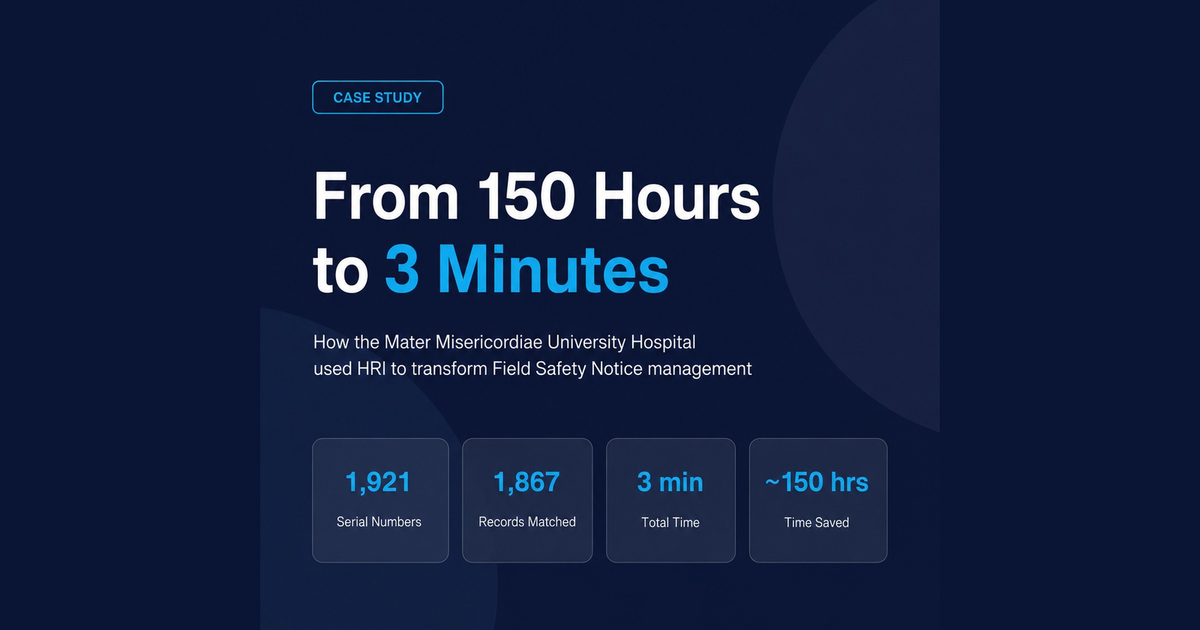
On 7 May 2026, the Mater Misericordiae University Hospital uploaded 1,921 device serial numbers from a Boston Scientific Field Safety Notice affecting the Accolade family of pacemakers and CRT-Ps into the Heart Rhythm International (HRI) Field Safety Module. Within 3 minutes, the system had matched 1,867 serial numbers to patient records, automatically identified 330 as deceased, flagged 33 duplicate serial numbers, and isolated 21 unmatched serials for investigation.
Under the previous manual process, the Mater estimates this would have required approximately 150 hours of physiologist time. The Field Safety Module compressed it into 3 minutes, with end-to-end workflow management and cross-hospital visibility built in.
We've used HRI for FSN management for years, but for a Field Safety Notice of nearly 2,000 devices, searching for each serial number one by one just isn't practical. With the Field Safety Module, we uploaded the full list and had every patient identified, categorised, and flagged in 3 minutes. It's a completely different capability.
Fiona Coughlan & Emmet O'Connor, CRM Clinical Specialists, Mater Misericordiae University Hospital
The Challenge: When Scale Outgrows Manual Processes
The Mater Misericordiae University Hospital manages an active follow-up population of approximately 7,000 patients with cardiac implantable electronic devices. For smaller advisories affecting a handful of devices, the existing serial-by-serial approach within HRI worked well: search for each serial number, check the patient's status, and manage the response through normal clinical channels.
But for a Field Safety Notice of nearly 2,000 devices, that approach breaks down. Each serial number must be individually searched, each patient's status manually verified, and each case individually documented and tracked. The Mater estimates this would have required approximately 150 hours of physiologist time, split between searching for serial numbers (~100 hours) and verifying patient status (~50 hours). With busy clinics to run, typically only one physiologist could be spared to work on the Field Safety Notice at any given time, meaning the process would have stretched across weeks.
Boston Scientific issued the Accolade SMR6 FSN in March 2026. The Mater uploaded the serial numbers into the Field Safety Module on 7 May. Under the old manual process, staff would likely still have been working through the identification phase.
The Boston Scientific Accolade SMR6 FSN
The Boston Scientific Accolade Field Safety Notice was the release of SMR6, a software update that added a daily impedance monitor to mitigate the potential for these devices to enter "Safety Mode" (a non-programmable mode) if a device were to exhibit high battery impedance later in its service life. The recommended action for patients under the FSN is a software update to be applied at the patient's next follow-up appointment. The FSN encompassed 1,921 individual device serial numbers for the Mater.
Estimated Manual Workload for This FSN
The Response: From Serial Numbers to Action Plan in 3 Minutes
1. Bulk Upload and Automated Matching
The Mater uploaded all 1,921 serial numbers in a single action. Within 3 minutes, the module had cross-referenced every serial number against the national registry and returned a categorised breakdown: 1,867 matched to patient records, 330 automatically identified as deceased, 21 unmatched, and 33 duplicates flagged. Previously, this step alone would have consumed the bulk of the estimated 150 hours of staff time.
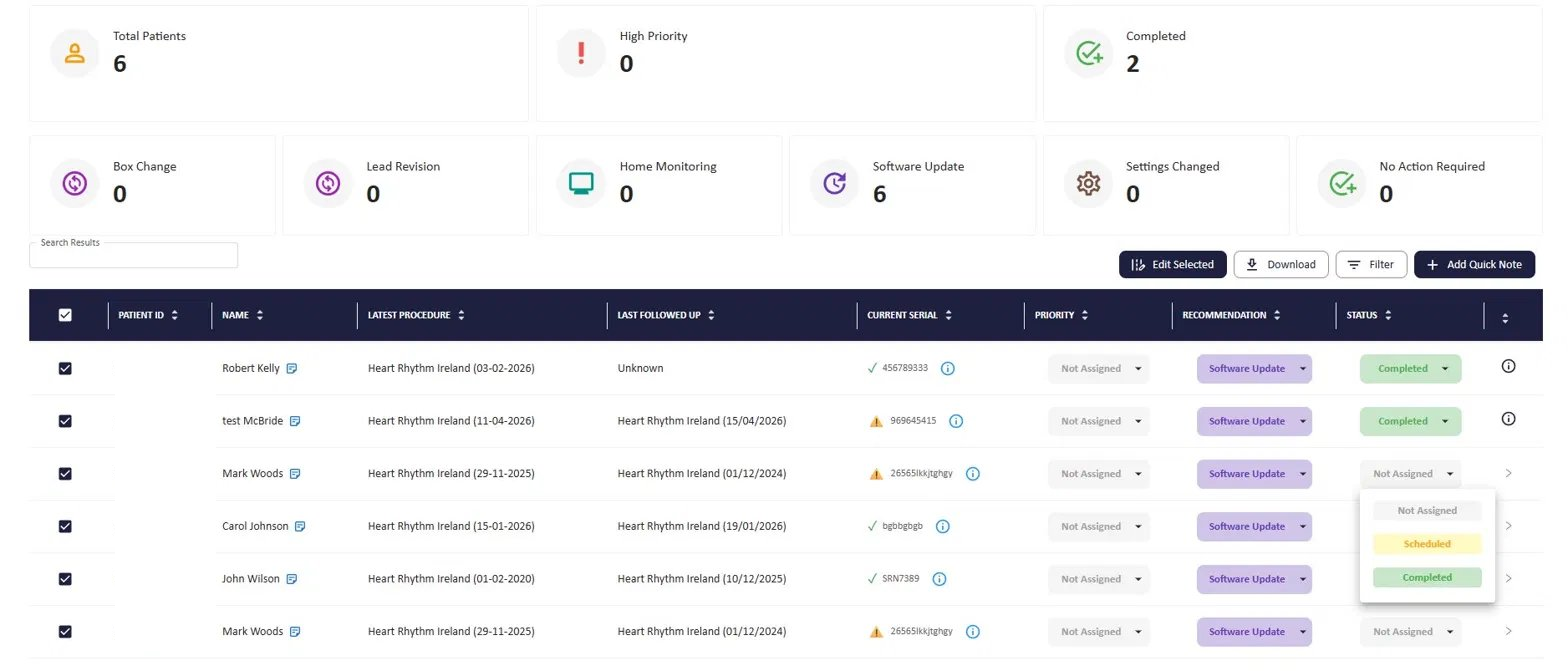
2. Recommendation Assignment and Patient Flagging
The 330 deceased patients were bulk-marked as resolved. The manufacturer's recommended software update was then assigned to all remaining living patients in a single action. A priority flag and clinical note were attached to every affected patient's HRI profile, visible to every clinician who accesses the patient's record at any participating hospital.
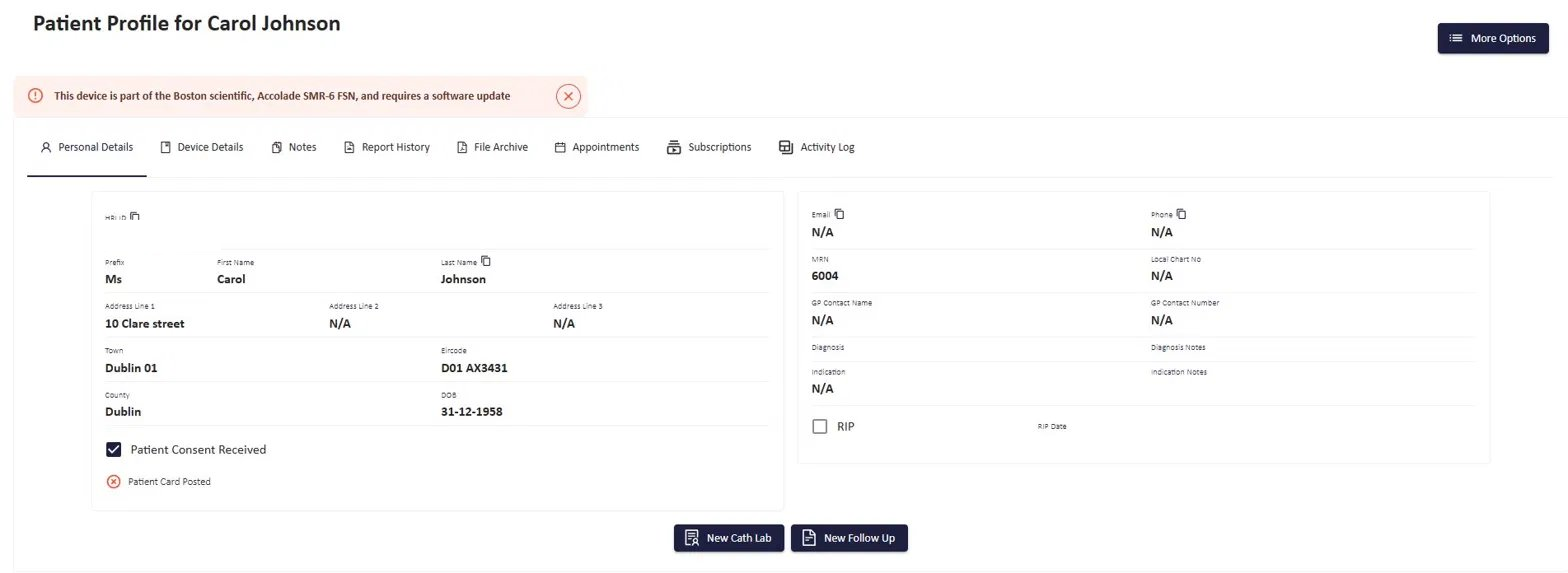
3. Live Dashboard and Completion Tracking
With identification and assignment completed, the remaining work is clinical: getting each patient through a follow-up appointment to receive the software update. As each patient is seen and the update applied, the treating physiologist confirms the action within HRI. A timestamped note is added recording what was done, when, and by whom. The Mater expects to work through all living affected patients over a 12-month period through routine clinic schedules.
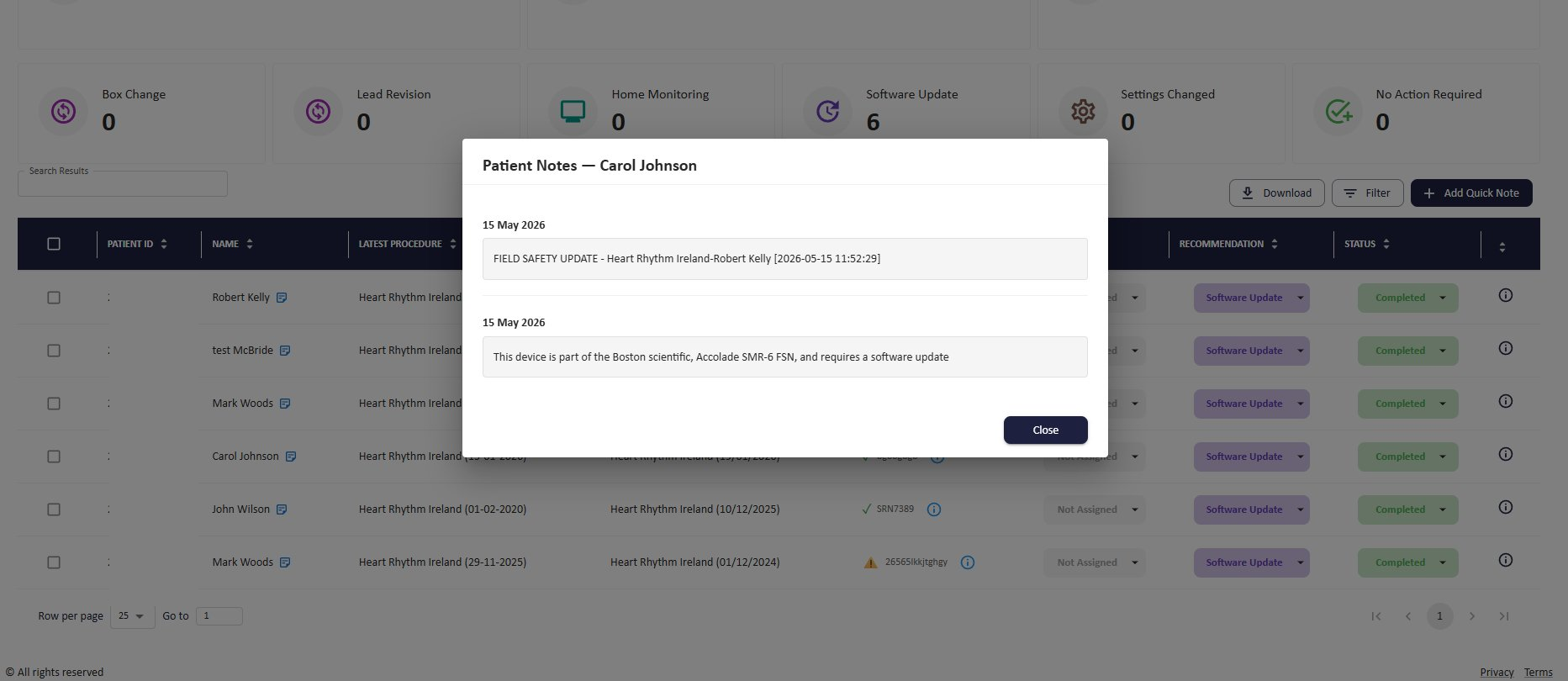
Cross-Hospital Safety Net: Proven in Practice Within the First Week
Within the first week, the cross-hospital capability was already working. As an implanting centre, the Mater holds serial numbers for patients who receive their routine follow-up device checks at smaller centres across Ireland. When an affected patient presented at any other HRI-connected hospital, the treating physiologist immediately saw the FSN flag and the clinical note.
Connolly Hospital Blanchardstown
An affected patient attended a follow-up at Connolly Hospital Blanchardstown four days after the FSN was uploaded. The treating physiologist saw the flag, applied the software update, and confirmed resolution within the system, leaving a note confirming “Software upgrade installed.” The patient’s profile was updated with a timestamped field safety entry recording the hospital, date, and completing physiologist. The Mater’s dashboard reflected the completion automatically, without any phone calls or emails between hospitals.
This capability eliminates one of the most persistent risks in FSN management: patients who receive follow-up care at a different hospital to where their device was implanted. Under HRI, they are caught automatically, regardless of where they present.
Results
| Metric | Outcome |
|---|---|
| Serial numbers processed | 1,921 uploaded and categorised in 3 minutes |
| Patient records matched | 1,867 of 1,921 serial numbers (97.2%) |
| Deceased patients identified | 330, automatically identified and resolved |
| Duplicates flagged | 33 |
| Time: upload to full identification | 3 minutes |
| Estimated manual process | Approximately 150 hours |
| Recommendation assigned | Software update assigned to all affected living patients in bulk |
| Cross-hospital follow-up | Proven in practice within the first week |
| Audit trail | Every action timestamped and attributed to named physiologist |
| Expected completion | 12 months through routine clinic schedules |
Why This Matters
Patient Safety. Automated matching ensures no patient is missed. Cross-hospital visibility flags affected patients regardless of where they present. The system makes it structurally difficult for patients to fall through the cracks.
Audit Readiness. Every action is timestamped and attributed, creating a comprehensive record that supports HPRA compliance and internal governance. Documentation is generated automatically, not assembled retrospectively.
Operational Efficiency. 150 hours compressed to 3 minutes. Staff time redirected from manual cross-referencing to direct patient care. Hospitals manage multiple FSNs per year, compounding the efficiency gain.
The Network Effect
The cross-hospital follow-ups recorded within the first week illustrate a fundamental truth: patients do not stay in one hospital. They transfer, relocate, and receive care across multiple sites over the lifetime of their device. An FSN flag set by the Mater follows the patient across every HRI-connected hospital in Ireland. When resolved elsewhere, the Mater's dashboard updates automatically. No phone calls, no emails, no risk of information lost in transit.
This network effect, where each additional hospital increases the safety net for every patient, is the core value of registry-based field safety management and the capability hardest to replicate without national-scale infrastructure.
Manufacturer Partnerships
Effective FSN management depends on close collaboration between device manufacturers, hospitals, and the registry. In this case, Boston Scientific provided the Mater with a comprehensive, high-quality list of 1,921 affected serial numbers, enabling rapid action with full confidence in the scope of the FSN.
HRI's Field Safety Module bridges the gap between the manufacturer's notification and the hospital's patient response. As FSNs grow in scale and complexity, this kind of registry-manufacturer partnership benefits all stakeholders: manufacturers who need assurance their advisories are acted upon efficiently, hospitals managing the operational workload, and regulators seeking evidence of systematic follow-up.
Implications for Other Markets
This workflow is fully transferable to any market with cardiac implant centres and regulatory requirements around device traceability. Even in a single hospital or trust, the Field Safety Module delivers immediate value by replacing manual serial-by-serial searching with rapid patient record matching, status identification, recommendation assignment, dashboard tracking, and audit-ready documentation. As additional hospitals, trusts, health networks, or state systems join the platform, the value compounds further by extending cross-site visibility and creating a broader patient safety net.
Learn More About HRI's Field Safety Module
See how HRI can help your hospital or network reduce FSN workload, improve audit readiness, and strengthen patient safety.
info@heartrhythmintl.com | www.heartrhythmintl.com
About Heart Rhythm International
Heart Rhythm International (HRI) operates Ireland's national cardiac device registry and clinical workflow platform for cardiac implantable electronic devices. HRI supports hospitals across the full device lifecycle, from implant data capture and device tracking through to follow-up management, post-market surveillance, field safety workflows, and audit-ready reporting. Used by the majority of implanting centres across Ireland, HRI connects public and private cardiac services through a living registry that helps clinicians manage device safety, traceability and patient follow-up at scale. HRI is now expanding internationally.