What Happens When the Data Starts Talking Back
After eighteen years of recording what happened, a national cardiac device registry starts revealing what may happen next.


Ahead of joining researchers from across Europe at the EU Horizon CARAMEL plenary in Italy, I have been reflecting on what Heart Rhythm International is contributing to this work.
HRI is a partner in the CARAMEL consortium, providing research outputs derived from Ireland’s national cardiac device registry to a European research programme exploring how AI can improve outcomes in cardiac care.
What stands out to me is that the dataset we have been quietly building in Ireland has reached the point where it can be used to explore questions that could reshape how we manage cardiac devices.
The implications may go further than many in the field have yet considered.
What the registry actually contains
HRI has been capturing cardiac device data across Ireland since 2008, across most public and all private implanting and follow-up centres. For the devices in the registry, the record is detailed and continuous. The implant. The serial number. The lead. Every follow-up, year after year, with the battery measurements, threshold checks and programming changes recorded alongside. Thousands of clinical notes documenting what actually happened to the patient over time. And the response when a Field Safety Notice lands.
That is not a database of serial numbers. It is a longitudinal clinical record of how cardiac devices behave in real patients, in real clinical settings, over real time. Some of the earliest records in the registry are now approaching two decades of continuous follow-up. A patient who received a pacemaker in 2008 has had that device monitored, measured, and recorded through every follow-up since.
When you accumulate that kind of data over that kind of timeframe, patterns emerge that are invisible in any single hospital, any single study, or any single manufacturer's post-market dataset.
From recording to predicting
The traditional role of a device registry is to record what happened. A device was implanted. A follow-up occurred. A battery voltage was measured. A lead impedance was recorded. The data goes in, and if someone asks a question later, the data comes out.
That model served its purpose for a long time. But it treats the registry as a filing cabinet. The data is stored, not interrogated. It answers questions that have already been asked, not the ones nobody has thought to ask yet.
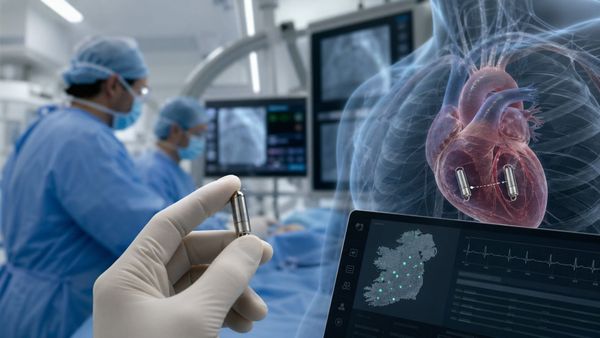
What changes when you apply AI modelling to a dataset of this depth and duration is that the registry stops being a record of the past and starts becoming a window into the future. Patterns that are invisible to a clinician reviewing one patient at a time become visible to a model reviewing hundreds of thousands of data points at once.
Battery degradation curves that vary by device model, by implant setting, by patient physiology, by programming configuration. Lead performance trends that may signal issues long before they become clinically apparent. Profiles that help distinguish which patients are most likely to need early intervention from those who can safely continue on routine follow-up.
This is not theoretical. Within the CARAMEL programme, and under its data governance and ethical framework, AI modelling has been applied to longitudinal device data of this kind within HRI's own environment, and the early work has been encouraging enough to take seriously. The detail belongs to the consortium and will be published through its formal deliverables. What I can say is the part that matters here. Eighteen years of structured, longitudinal, device-level clinical data holds predictive information that has not been systematically extracted before.
What a registry can see that nobody else can
Manufacturer specifications tell you what a device is designed to do. Clinical trial data tells you how it performed under controlled conditions, in a selected population, for a defined period. Neither tells you how a device performs across the full spectrum of real patients, in real hospitals, over real years of follow-up.
A national living registry does. Battery longevity by device model. Lead survival over five, ten, and fifteen years. Complication rates by device type, by patient demographic, by implanting centre. Reoperation rates. Upgrade patterns. Failure modes. All of it captured as a by-product of routine clinical care, rather than as a funded study with selection bias and limited follow-up.
Manufacturer-led post-market surveillance is rigorous, but it has an inherent limit. Each manufacturer can only see its own devices. It knows how its own pacemaker performs. It does not know, from its own data, how that pacemaker compares to a competitor's in the same patient population, in the same hospitals, over the same timeframe.
A national registry sees all of it. Every manufacturer. Every device. Every outcome. Side by side, in the same clinical environment, under the same follow-up protocols. For a manufacturer whose devices perform well in the real world, that is the most credible evidence available, because it cannot be dismissed as marketing and it cannot be questioned as biased. It is simply what happened, recorded by clinicians who had no commercial interest in the result.
This is the kind of independent, real-world evidence that strengthens every decision taken downstream of it, from how a patient is followed up to how a health system understands the technology it depends on. It does not replace clinical judgment. It gives clinicians something they have rarely had: an independent, longitudinal, population-level view of how these devices actually behave.
The regulatory context
The EU Medical Device Regulation requires robust post-market surveillance and real-world evidence. The European Health Data Space is being built on the premise that health data captured in routine care should be usable, under proper governance, for research and innovation. National cardiac device registries sit at the intersection of both. When AI is applied to that data, they generate insight that neither framework fully anticipated but both are designed to welcome.
The infrastructure underneath
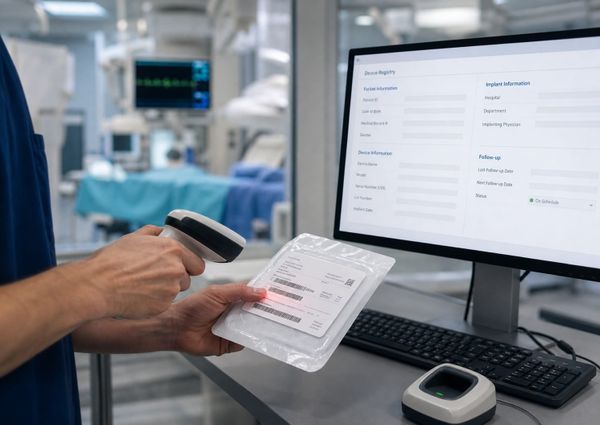
None of this is possible without the infrastructure to capture the data in the first place. Accurate device identification at the point of implant. Structured follow-up recording across every participating hospital. Cross-hospital visibility, so a patient seen at a different centre is not lost to the dataset. Longitudinal continuity, so a device implanted in 2008 is still being tracked in 2026.
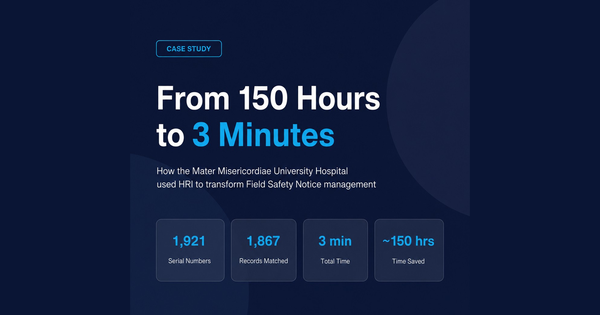
The same dataset that identified 1,867 patients from 1,921 serial numbers in three minutes during a recent Field Safety Notice at a major Dublin teaching hospital is the dataset now contributing to predictive research. The infrastructure that delivers operational value today is the infrastructure that generates research value tomorrow.
Building that infrastructure takes time. It takes clinical trust. It takes governance. It takes persistence through the years when nobody is asking the questions the data will eventually answer.
You cannot decide to build a predictive model and then work backwards to the data. The data has to exist first. It has to have been captured consistently, accurately, and over a long enough period to contain the patterns that matter.
Eighteen years is a long time to build something before the world catches up to what it can do. But that is the nature of health data infrastructure. Its value is not obvious when you start. It becomes obvious when you have enough of it, over enough time, to see what was always there but never visible.
That is where we are now. And the conversation about what to do with it is only beginning.